

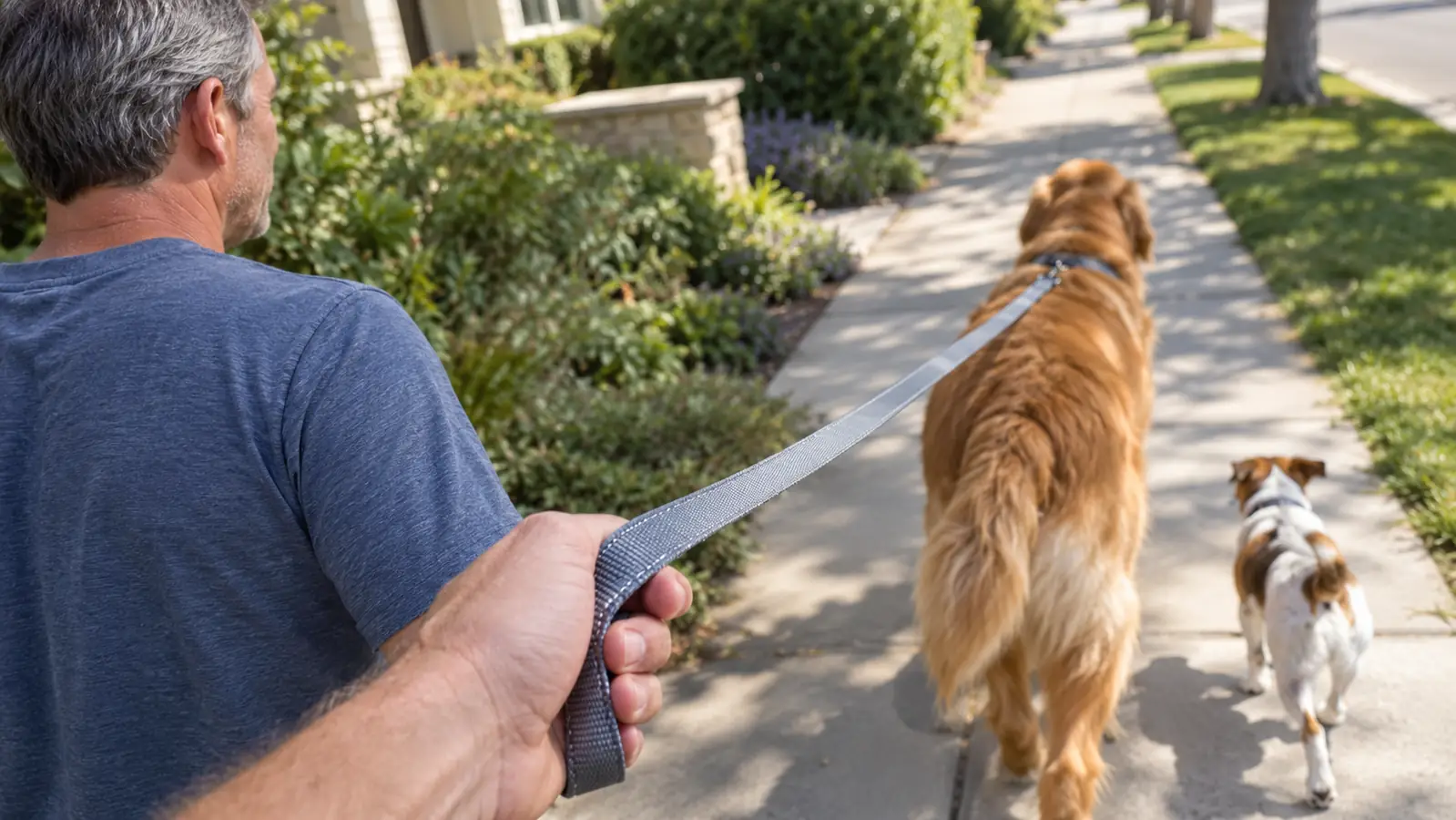
When I switched from a retractable leash to a 6 foot fixed leash for Tucker, my 70 pound shepherd mix, I expected to lose a little freedom. What I actually lost was the constant worry that a squirrel on the other side of the street would turn into a sudden 70 pound bolt. This is not a debate about leash length. It is a debate about control, and after two months of daily walks with both styles, I have a clear answer. The Joytale 6 ft reflective leash has been on every walk since early March, and I have not once wished for the retractable's extra reach. The first week I used it, Tucker tried to lunge after a cat on our neighbor's porch. With the retractable, that lunge would have carried him ten feet before the lock caught. With the Joytale, he moved maybe two feet, and I had already braced myself. The difference is not subtle. It is the difference between walking a dog and being dragged by one.
I am not going to pretend the retractable has no good points. For a small dog like Daisy, who weighs 25 pounds and does not pull, the extra length lets her explore the ditch without me stepping off the path. On a wide open trail with nobody around, letting her walk twenty feet ahead is a nice way to give her a little freedom without carrying a long line. But the retractable's best feature is also its worst. The lock mechanism works, but it takes a deliberate press of the button with your thumb, and that half second matters when a cyclist comes around a blind corner. I had one close call in April when Daisy darted after a rabbit and the cord snapped tight, and the handle whipped back toward my wrist. It did not hurt, but it was a reminder that the retractable gives the dog more freedom than I can safely manage in most of the places we walk. The Joytale, on the other hand, keeps the dog within arm's reach at all times, and that is exactly what I need for Tucker.
| Joytale 6 ft | Retractable | |
|---|---|---|
| Length | Fixed 6 feet, no slack beyond your hand | Variable 3 to 26 feet of cord |
| Control | Your hand is the only brake, immediate response | Lock mechanism, then a second to release |
| Safety | No sudden slack, less risk of tangling or snapping | Cord can snap or wrap around legs, handle can whip back |
| Durability | Nylon webbing, stitched loops, machine washable | Thin cord, plastic housing, prone to wear |
| Best for | Dogs that pull, need close control, or are still training | Well-trained small dogs in open areas with no traffic |
Where Joytale Wins
The biggest difference is what happens when Tucker sees a cat. With the retractable, the lock engaged a half second after he started moving, which meant he was already three feet ahead and leaning. With the Joytale, there is no lock. My hand is the lock, and because the leash is only six feet, I have time to plant my feet and let the tension do the work. Tucker can still pull, but he cannot build up the same speed, and that extra second of warning has kept me upright on more than one morning. I measured the difference one Saturday by walking the same stretch of sidewalk with both leashes. With the retractable, Tucker's reaction to a passing dog pulled me about eight feet before I could stop him. With the Joytale, I stopped him within three feet, and I did not have to dig my heels in as hard. That is the kind of control that matters when you are walking a dog who outweighs you. The handle on the Joytale is also a big part of it. The loop is padded and wide enough for my whole hand, even with a work glove on, so I can keep a firm grip without the leash slipping. The retractable's plastic handle forced me to hold it with two fingers, which left me less ready for a sudden pull. On a rainy Tuesday in April, the Joytale stayed dry in my hand because the nylon does not soak up water the way the retractable's cord did.
The reflective stitching is not a gimmick either. On the evening walks in January, before daylight saving, the headlights of a pickup caught the leash from maybe a hundred feet away, and the whole length lit up. I also like the loop at the handle. It is big enough for my hand even with a glove on, which the retractable's plastic handle never was. The leash has been through the wash twice after Daisy decided to roll in something she found, and the stitching has not frayed. The clip is a simple metal snap that has never once popped open, even when Tucker wrapped the leash around a fence post and gave it a hard yank. That same afternoon, the retractable's clip had already come loose once, which is why I stopped using it for Tucker altogether. I also like that the Joytale does not have a bulky housing. It coils into a neat loop that fits in my jacket pocket, and it does not drag on the ground when Tucker walks close. The retractable, by contrast, always had the cord dragging and picking up mud, and the housing was too big for any pocket I own.
One more thing I appreciate is the simple design. There are no moving parts to fail. The retractable has a spring, a lock, and a button, all of which can break. My old retractable's button stuck after about a year, and the cord stopped retracting properly. The Joytale is just a length of webbing with a clip on one end and a loop on the other. That is all it needs to be. It does not have a mechanism that can wear out or jam. I have owned the Joytale for two months now, and it still looks the same as the day it arrived. The stitching on the clip is tight, the reflective thread has not faded, and the webbing has not stretched. For a piece of gear that I use twice a day, every day, that simplicity is a big reason I trust it.
Where Retractable Wins
I am not going to pretend the retractable has no good points. For a small dog like Daisy, who weighs 25 pounds and does not pull, the extra length lets her explore the ditch without me stepping off the path. On a wide open trail with nobody around, letting her walk twenty feet ahead is a nice way to give her a little freedom without carrying a long line. The retractable also stores flat in a jacket pocket, which the Joytale does not. When I walk Daisy alone, the retractable is genuinely easier because I do not have to worry about her building up speed. She trots along at the end of the cord, and I can let her sniff a bush ten feet away while I stay on the gravel. That is something a fixed leash cannot do. For a calm, small dog in a safe, open space, the retractable is a legitimate tool, and I would not tell anyone to throw it out if that is their situation. I used it on Daisy for three years before I switched, and it served her fine because she never pulled. The cord is thin enough that she barely notices it, and the handle fits her small frame. On a sunny Sunday walk along the canal, I let her range a full twenty feet, and she came back when I called. That kind of freedom is nice for a dog who has earned it.
But the retractable's best feature is also its worst. The lock mechanism works, but it takes a deliberate press of the button with your thumb, and that half second matters when a cyclist comes around a blind corner. I had one close call in April when Daisy darted after a rabbit and the cord snapped tight, and the handle whipped back toward my wrist. It did not hurt, but it was a reminder that the retractable gives the dog more freedom than I can safely manage in most of the places we walk. The Joytale, on the other hand, keeps the dog within arm's reach at all times, and that is exactly what I need for Tucker. I also found that the retractable's cord can wrap around my legs if Daisy circles me. That happened twice, and both times I had to stop and unwind it. With the Joytale, there is no cord to wrap. The webbing is flat, so it lies against my leg without tangling. And when Tucker is on the retractable, he can build up enough speed to yank the handle out of my grip. That has never happened with the Joytale, because he cannot get more than six feet away before the leash tightens.
I will also say that the retractable is better if you need to keep your hands free for a moment. The handle has a loop that you can slip over your wrist, and the lock can hold the leash at a set length. That lets you pick up a bag or answer your phone without dropping the leash. The Joytale does not have that feature. You have to hold it, and if you let go, the dog is free. That is a real advantage for a retractable, and it is the main reason I keep one in the car for quick trips to the vet where I need both hands. I just do not use it for Tucker because the risk of a sudden pull outweighs the convenience.
For daily walks where you need real control, the Joytale 6 ft leash is the one I trust with Tucker.
It has held up for two months of hard use, the reflective stitching shows up at night, and the handle gives me a grip I can actually hold. If you have a puller or a dog still learning, this is the leash to try.
Amazon Check Today's Price on Amazon →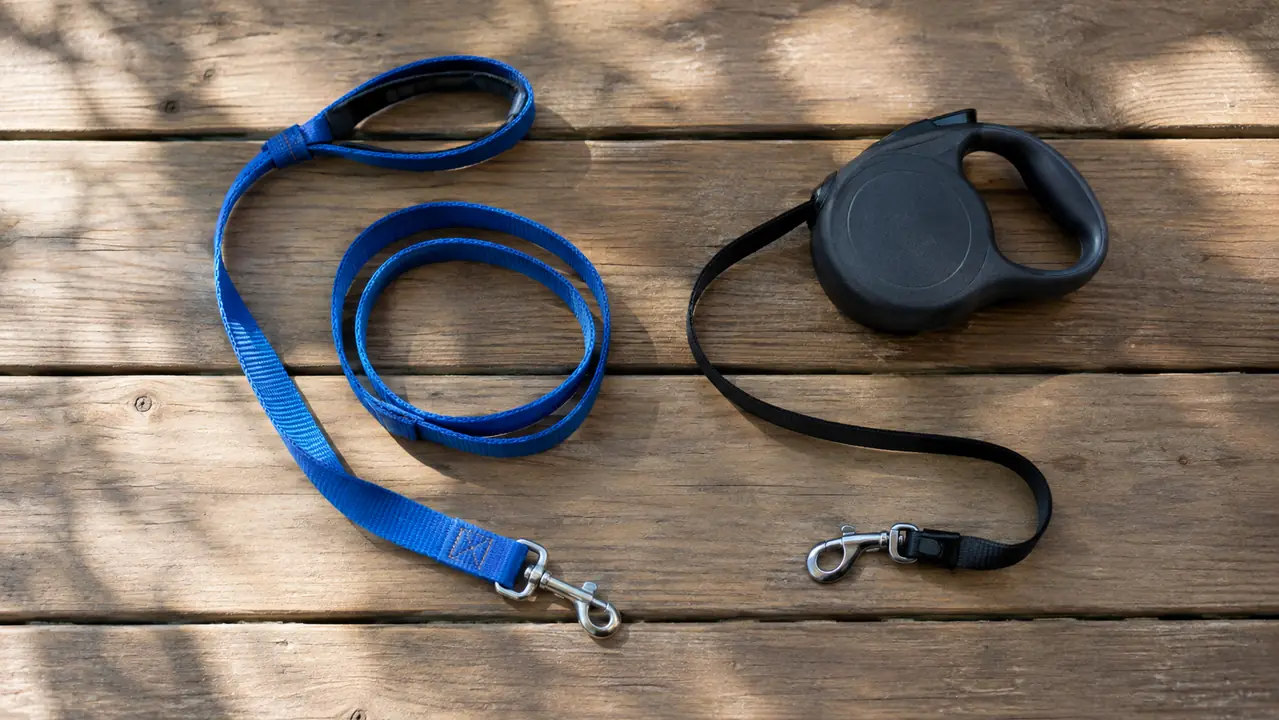
Who Should Buy Which
Who should buy the Joytale? Anyone with a dog that pulls, a dog that is still learning, or a walker who wants to feel the leash in their hand at all times. I use it for Tucker on every walk, and it is the only leash I take to the vet or the park. Who should skip it? If your dog is small, already walks loose-leash, and you stick to wide open spaces, the retractable gives you flexibility. But for the two dogs I own, the Joytale is the safer choice. The retractable is not a bad tool; it is just the wrong tool for a 70 pound dog who still thinks every squirrel is a personal challenge. If you are deciding between the two, ask yourself one question: do you want to be in control of the distance, or do you want the dog to decide? The Joytale puts that control in your hand, and that is worth a lot when you are walking a big dog in a neighborhood with traffic.
If you are still deciding, I would recommend trying the Joytale first. It is cheaper to replace if it wears out, and it does not have a mechanism that can break. The retractable is fine for a calm dog in an empty field, but for most of the places I walk, which are sidewalks and trails with cars and bikes, the fixed leash is the safer choice. The Joytale has also made me a better walker. I pay more attention to Tucker's body language because I can feel every shift in his weight through the leash. That feedback is something a retractable cannot give you, because the cord absorbs all the small movements. If you have ever wanted to feel more connected to your dog on a walk, that alone is worth the switch.
If you are still on the fence, I would say get the Joytale.
It costs about the same as a retractable, it lasts longer, and it keeps your dog closer. That is the trade I am happy to make.
Amazon Check Today's Price on Amazon →