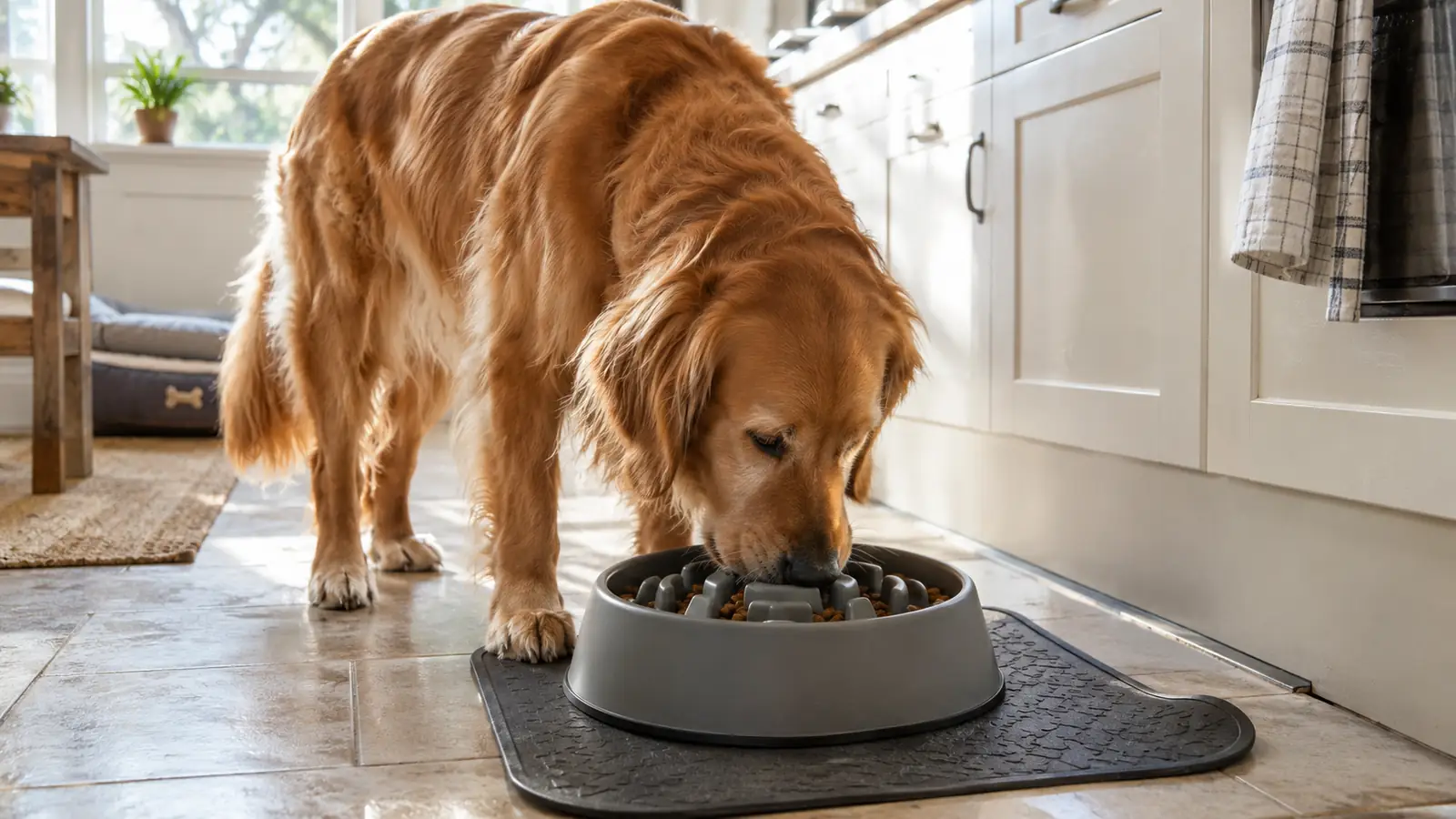
Nobody warns you about the sound. When I set the Outward Hound Fun Feeder down for Tucker for the first time last March, the scrape of plastic on ceramic tile was loud enough to bring my wife in from the other room. She stood in the doorway watching our 70-pound shepherd mix work his way around the ridges, tongue flicking into the gaps, and after about a minute she just said, 'Well, that's going to take him a while.' She wasn't wrong. His old flat bowl was empty in forty seconds. This one kept him busy for close to twelve minutes, and for the first time since we adopted him, the floor around his bowl stayed dry.
Tucker inhales food. He always has. We adopted him at two and he ate like he was expecting the bowl to vanish. The vomiting after meals got bad enough that our vet suggested a slow feeder, and I bought the Outward Hound because it was the one every review seemed to land on. This is the honest part of that review: it fixed the problem, and it created a few new ones I wish somebody had told me about before I ordered it. So here is the full picture after six months of daily use, the good, the annoying, and the parts the product photos leave out.
The Quick Verdict
It slows Tucker's eating from forty seconds to twelve minutes and stopped his post-meal vomiting within a week, but it needs a bottle brush to clean and it is not a bowl every dog will accept.
Amazon Check Today's Price →Slowing down a fast eater is one cheap fix away
Tucker stopped vomiting within a week of switching to the Fun Feeder, and the bowl has held up through six months of daily use. Check today's price on Amazon and read the size chart before you order.
Amazon Check Today's Price on Amazon →How I've Used It
Tucker is a 70-pound mixed-breed shepherd type, six years old, and he has never once in his life eaten slowly. Daisy, our nine-year-old terrier mix, is the opposite. She nibbles, takes a break, comes back, and sometimes leaves a third of her dinner for the morning. So my setup involves two bowls in different rooms, and the Fun Feeder has been Tucker's daily bowl since March of this year. That is roughly six months of two meals a day, every day, including a stretch in July when the Bakersfield heat made us all cranky and Tucker decided his morning kibble was negotiable.
I started with the medium size because the listing says it holds two cups, and Tucker gets about two and a half cups across two meals. It fits that amount with room to spare. I filled it dry at first, then switched to adding a little warm water and a spoonful of pumpkin on the days his stomach seemed off. The ridges do the work either way. The one thing I changed was where I put the bowl. The non-slip base is real, but on our ceramic tile it still slides a little when Tucker really commits, so I set it on a rubber mat from the kitchen drawer. That mat is now a permanent part of the setup, and I keep a second one under Daisy's flat bowl so neither dog is eating off bare tile.
There was one day I nearly gave up on it. In late April, a rain that caught us off guard left the backyard muddy, and Tucker came in soaked and covered in wet dirt. He went straight for his bowl the way he always does, and within a minute the bottom of the Fun Feeder was a mess of mud and wet kibble. I spent ten minutes with the bottle brush getting the channels clean, and I almost switched back to the flat bowl that night. I did not, because the vomiting had stopped and I knew the mess was my problem, not the bowl's. But I do wish somebody had told me to keep the feeder away from the mud zone, because that was the closest I came to tossing it in a drawer.
One detail worth mentioning: I feed Tucker twice a day, around seven in the morning and six in the evening, and the Fun Feeder gets used exactly that often. On weekends we sometimes do a third small meal, and the medium holds it fine. The routine is the same every time. Bowl on the mat, two scoops of kibble, a little water, and Tucker waits at the edge of the kitchen until I set it down. He does not dive in the way he used to, which is the whole point.
What the Ridges Actually Do
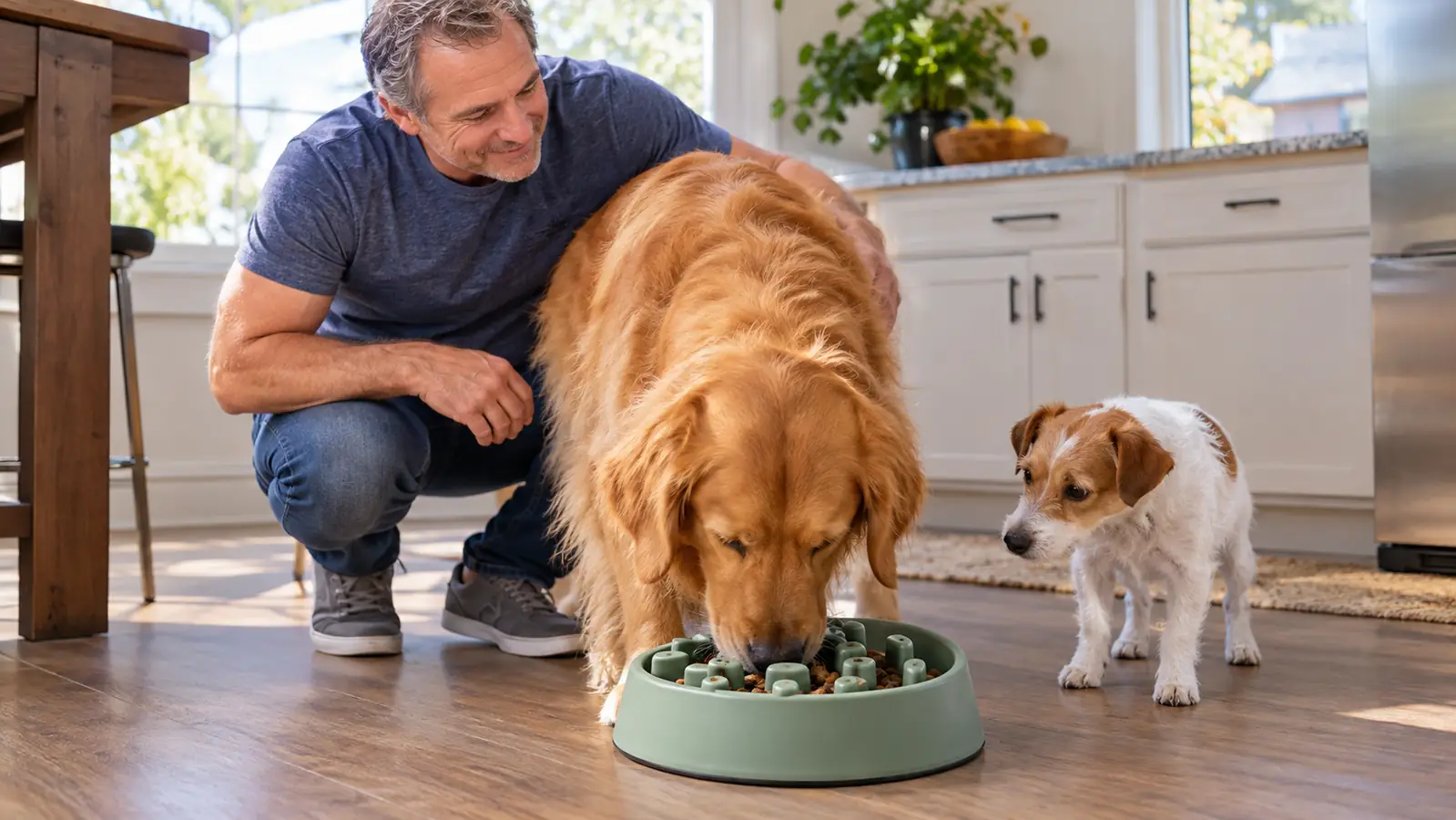
The pattern is a series of raised walls that curve back on themselves, so the kibble falls into pockets the dog has to work around. What nobody tells you is that the geometry matters more than the depth. The medium's ridges are tall enough that Tucker's snout has to dip and angle, but not so tall that he gets frustrated and flips the whole thing. He learned the motion in about two days. Day one he nudged the bowl across the mat trying to knock kibble loose, and I worried I had bought a bowl that would just frustrate him. By day three he had figured out that tongue-first was the only way to reach the bottom pockets, and he stopped fighting it.
The other thing the marketing photos do not show: the bottom pockets hold the last few pieces hostage. On a normal bowl, Tucker licks it clean in one sweep. With the Fun Feeder, there are four or five kibble bits wedged into the corners of the pattern that he cannot reach with his tongue. On most days he walks away leaving those, and I rinse them out when I wash the bowl. It is a small thing, but it means the bowl is never truly empty at the end of a meal, which bothered me more than I expected.
The ridges also slow down a determined eater in a way that surprised me. I expected Tucker to find a shortcut, and he did try. He worked the outer ring first because that is where the kibble lands, and the middle of the bowl sat untouched for the first few minutes. By the time he got to the center, he was already eating at a normal pace. The design does the slowing work for you, which is the whole point, but it took me about a week to trust that it was actually working and not just making him frustrated.
Cleaning: The Part Nobody Tells You
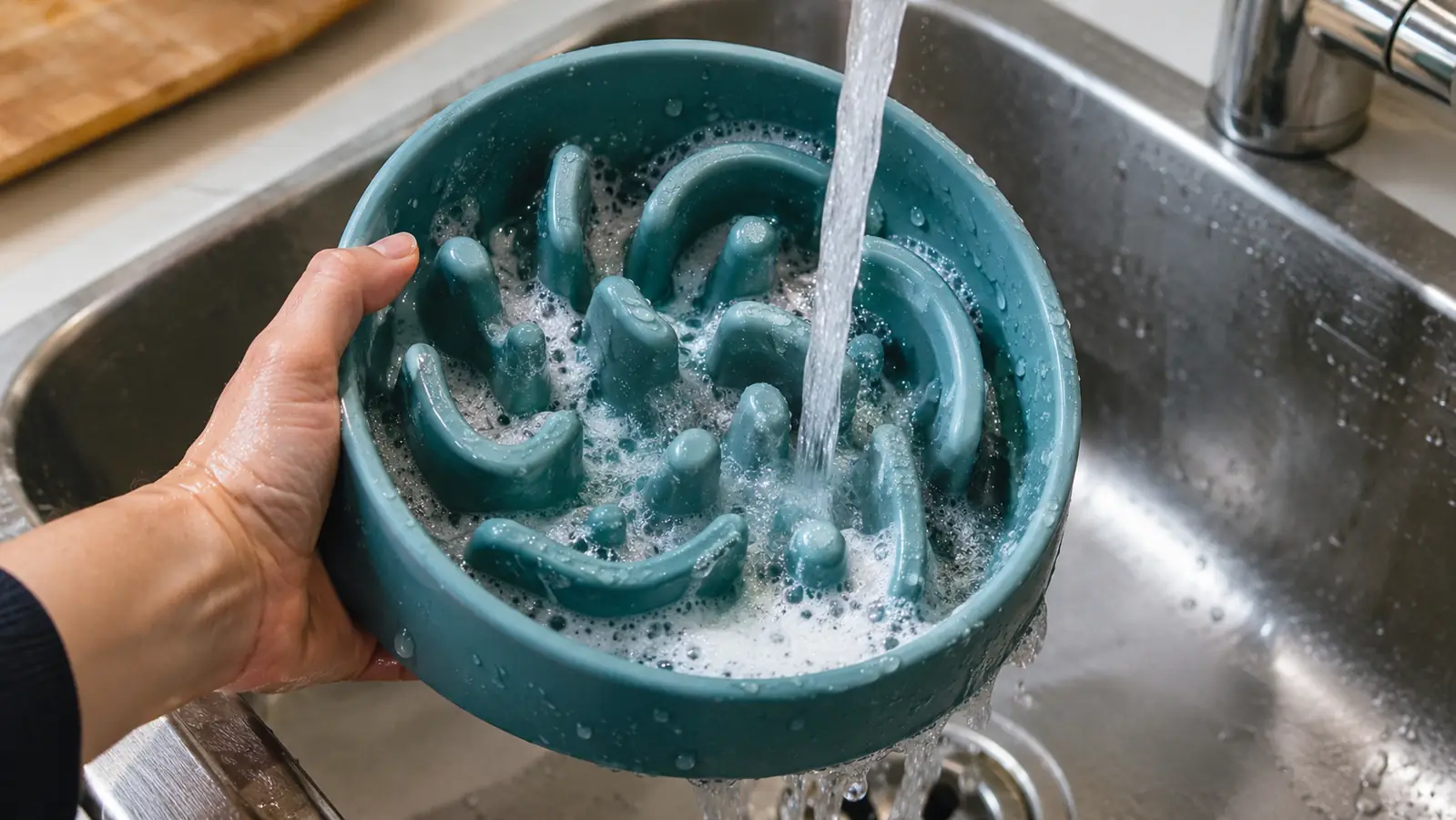
The Outward Hound Fun Feeder is dishwasher safe on the top rack, which sounds great until you remember that the whole point is a bunch of narrow channels. Food gets packed into the grooves and a rinse does not touch it. I wash it by hand most nights with a bottle brush, and even then I have to run the brush along each ridge to clear the residue. A sponge will not do it. I learned that the hard way after a week of hand-washing with a sponge and finding a faint film of old kibble dust collecting in the bottom of the pockets. That film smelled, and it took a proper soak to get rid of it.
The dishwasher does a better job than I expected as long as I angle the bowl face-down so the spray hits the channels directly. I also run it through a cycle every few days instead of relying on hand washing alone. The plastic has held up fine through all of it. No warping, no staining, no cracked ridges. Six months in, it looks close to the day it arrived, aside from a few scratches on the bottom from being dragged across the mat. I will say the scratches are cosmetic and nothing more. The bowl has not weakened anywhere, and the non-slip ring is still intact, which surprised me given how much abuse it takes.
My cleaning routine is simple now. Every morning I rinse the bowl with hot water and wipe the worst of the residue off with a sponge. Every other evening I use the bottle brush on the channels. Every few days it goes in the dishwasher face-down. That routine takes about two extra minutes a day compared to a flat bowl, and it is the tradeoff for the slowing effect. If you are not willing to do that, this is not the bowl for you, and I mean that honestly.
Tucker went from emptying a bowl in forty seconds to taking twelve minutes, and the vomiting stopped within a week.
What It Did for Tucker (and What It Didn't)
The numbers are easy to track because I timed him out of curiosity. Old bowl: forty seconds, maybe less. Fun Feeder on day one: about six minutes, with a lot of nudging and a little frustration. After a week of practice: eleven to twelve minutes, steady, no drama. The vomiting stopped within a week, which was the whole point. Our vet had said slow eating would help, and it did. I also noticed Tucker seemed more settled after meals, less like he was in a hurry to get away from the bowl and more like he had actually finished eating.
What it did not do: it did not make Daisy touch the thing. Daisy is a nine-year-old terrier mix, twenty-five pounds, and she will not eat from the Fun Feeder at all. She sniffed it once, took a single piece of kibble out of a corner, and walked away. I think the ridges confuse her. She is a slow, careful eater by nature and the raised walls seem to frustrate her more than help. So we kept her flat bowl and the Fun Feeder is Tucker's alone. That is the honest part nobody puts in the product photos: a slow feeder is not a universal fix, it is a tool for a specific dog, and you will not know if your dog accepts it until you try.
I also noticed a change in how fast he finishes. The first week, he would eat for six minutes and then wander off and come back for the last pockets a few minutes later. Now he stays at the bowl for the full twelve minutes and finishes in one sitting. That matters for us because Daisy grazes all day, and a dog that is done in one clean session is easier to manage when you have two dogs on different schedules.
Sizing and Fit
Outward Hound makes this in several sizes and the medium is meant for small to medium dogs and cats. Tucker is not small or medium, he is seventy pounds, and the medium still works for him because the capacity is what matters. Two cups fits comfortably, and I have even loaded it with three cups on the days Tucker gets extra. The listing's size chart is worth reading before you order, because the notches and the capacity are tied together and guessing wrong means either a frustrated dog or a bowl that is too small. If your dog eats more than three cups in a sitting, I would size up.
The non-slip base is a ring of grippy material on the bottom. On our tile floor it helps, but as I said it is not a complete solution. On a hard surface with a determined dog, you still want a mat underneath. On carpet it stays put without help. I also noticed the bowl is a little light, so a very strong dog could in theory flip it if they tried hard enough. Tucker never did, but he is not the chewing type. A dog that likes to pick things up and throw them might treat this like a toy, and that is worth knowing before you hand it over to a dog that chews.
What I Liked
- Slows Tucker from forty seconds to twelve minutes
- Stopped his post-meal vomiting within a week
- Survived six months of daily use with no warping or cracking
- Dishwasher safe on the top rack, easy enough with a bottle brush
- Non-slip base holds well on carpet and with a mat on tile
Where It Falls Short
- Hand washing requires a bottle brush, a sponge will not reach the channels
- Bottom pockets trap the last few pieces of kibble out of reach
- Light bowl can slide on hard floors without a mat
- Not a universal fix, Daisy refuses to use it
Who This Is For
Buy the Fun Feeder if you have a dog that inhales food the way Tucker does. If your dog finishes dinner in under a minute and you are cleaning up vomit afterward, this is the cheapest fix I found, and it is the one that worked for us. It also works well if you have a dog that needs a little mental work at mealtime, because the pattern forces them to slow down and think. And if you want something that will survive a dog that is hard on gear, the plastic has held up better than I expected over six months. Tucker is a strong chewer and he has never once tried to chew the bowl, but he does drag it around on the mat and it has taken that without complaint.
It is also a decent option if you want to slow down a cat, since the listing covers cats too, but I cannot speak to that from experience. What I can tell you is that for a fast-eating dog, the change was obvious within the first week, and it has stayed that way for six months. That consistency is the reason I am still using it.
Who Should Skip It
Skip it if your dog eats slowly already. Daisy does not need it and she will not use it, so it would be money spent on a bowl that sits in a cabinet. Skip it if you hate hand washing dishes with narrow grooves, because this thing needs a brush and a soak on a regular basis. Skip it if your dog is the type to pick a bowl up and toss it, because the medium is light. And if you are on the fence about size, measure your dog's daily portion before you order, because the capacity is the whole game. I made that mistake with a different slow feeder once, and the dog figured out how to flip it in a day.
The right bowl is the one your dog actually eats from
After six months of daily use, the Fun Feeder earned its place in Tucker's routine. If your fast eater needs the same fix, check today's price on Amazon and read the size chart first.
Amazon Check Today's Price on Amazon →