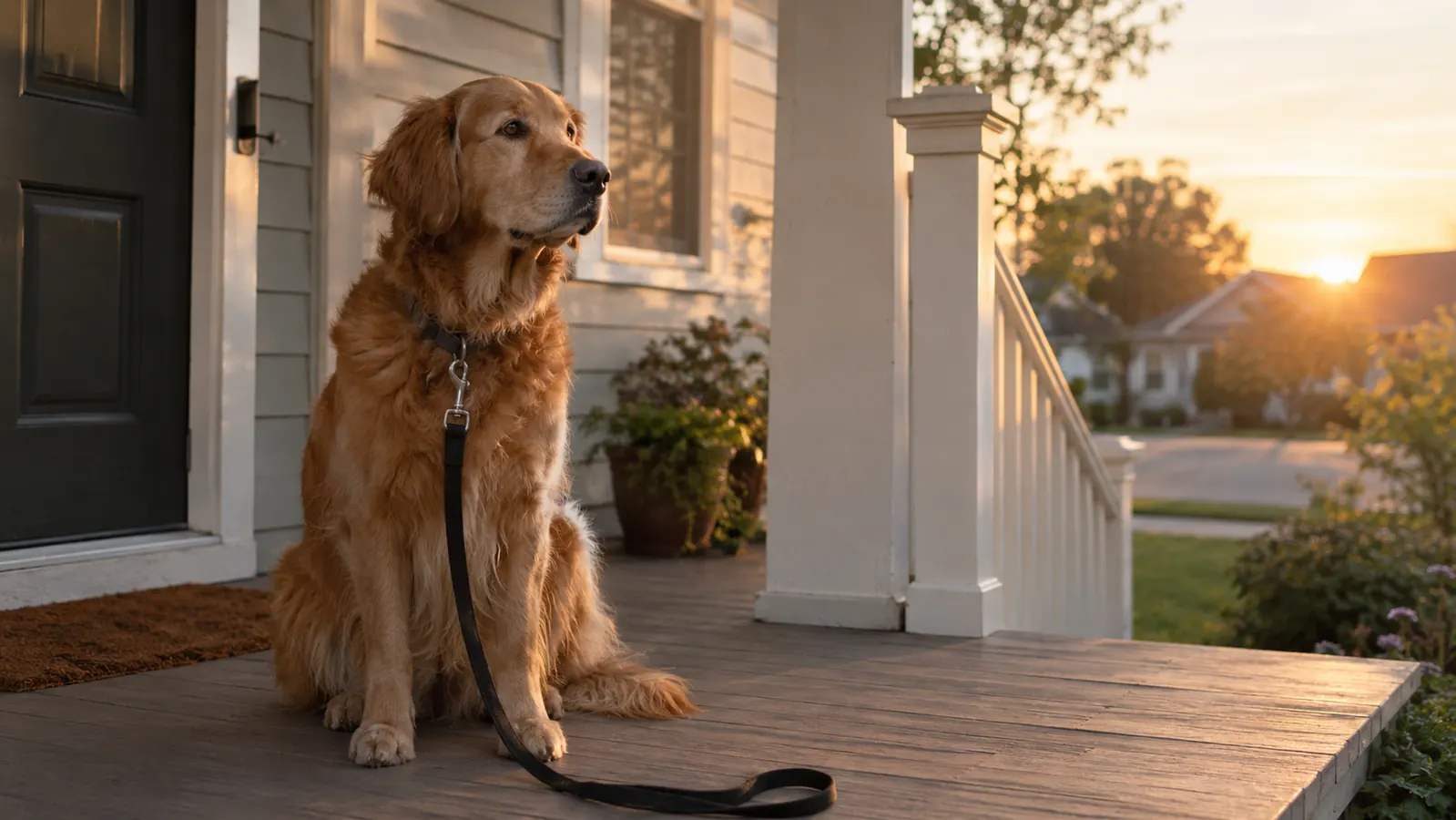
Every walk with Tucker used to start the same way. I'd clip the leash to his collar, open the front door, and for the next thirty minutes I'd be hauling a seventy pound dog down the street while he lunged toward every smell, every squirrel, and every neighbor's fence. My shoulder ached by the time we got home, and I'd already started dreading the next walk. Tucker didn't see it that way. For him, a walk was the best part of the day, and he wasn't about to let my pace slow him down.
Before I got to the rabbitgoo No Pull Harness, I tried the usual things. A shorter leash. A training collar that I hated using on him. A cheap front clip harness from a big box store that Tucker figured out how to squirm out of in about three days. Nothing stuck, and I was starting to think we were just stuck with bad walks. The turning point came when I stopped trying to correct the pulling and started working with a harness that actually gave me some leverage. The rabbitgoo has two leash clips, one on the back and one on the chest, and that chest clip is the whole ballgame. Here's the exact routine I used, step by step, to get Tucker walking loose leash.
Start with a harness that gives you two ways to clip the leash
The rabbitgoo No Pull Harness has a back clip for calm dogs and a front chest clip that gently turns a puller back toward you. It's the piece that finally made loose leash walking click for us.
Amazon Check Today's Price on Amazon →Step 1: Get the fit right before you do anything else
A harness that's too loose is a harness your dog can back out of, and a harness that's too tight will chafe. Either way, the training fails before it starts. I measured Tucker's chest at the widest point, right behind his front legs, and he came in at about 28 inches. That put him solidly in the medium size for the rabbitgoo. The sizing chart on the listing is accurate, but measure anyway, because a 70 pound shepherd mix and a 55 pound lab can have the same chest girth.
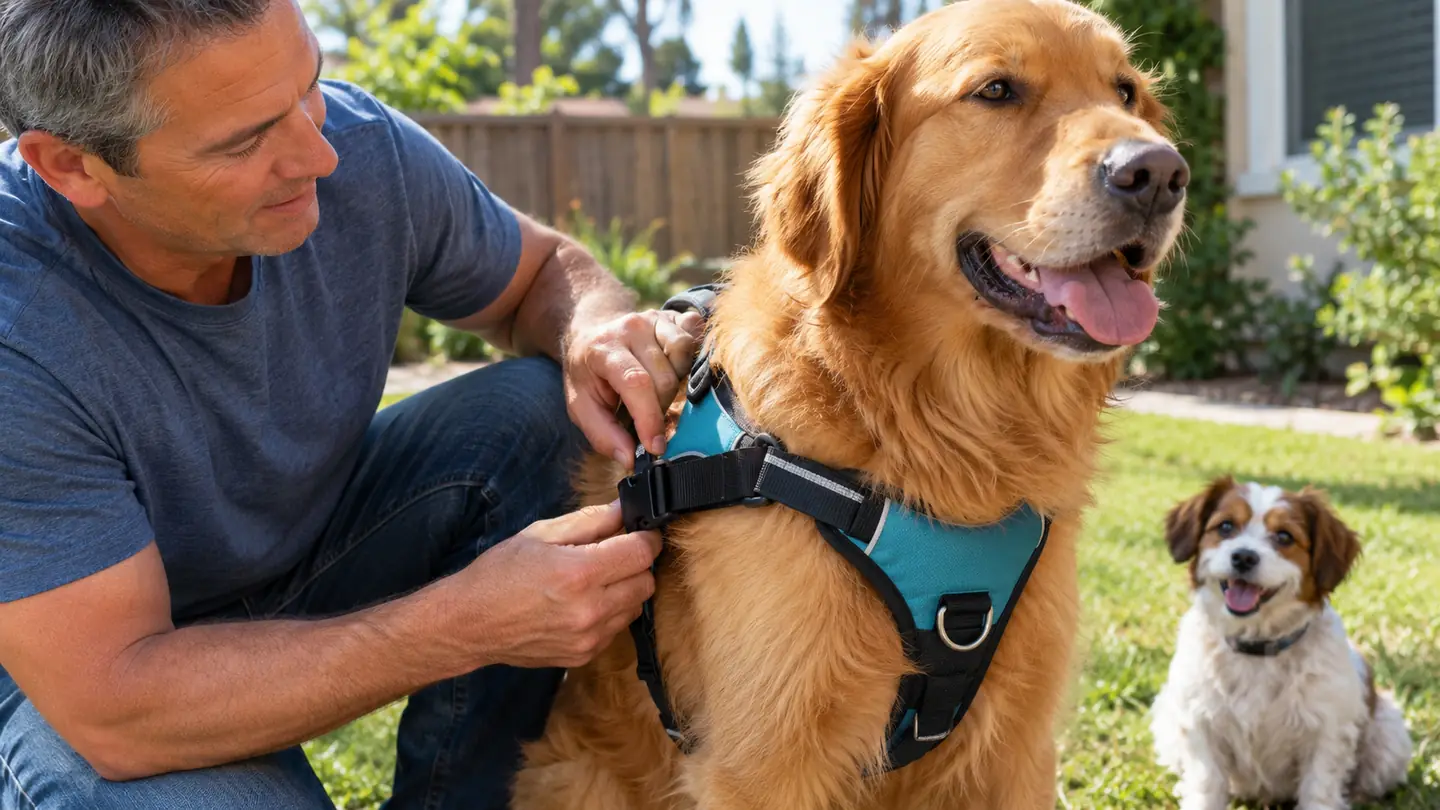
When you put it on, the harness goes over the head like a vest, then the two belly straps buckle underneath. I adjusted the straps so I could fit two fingers flat between the webbing and Tucker's chest. That's the sweet spot. Too snug and he'd rub, too loose and he'd step right out of it the way he did with the old one. The first time I put the rabbitgoo on him, he stood there looking at me like I'd attached something to his body, then he shook once and went back to sniffing the yard. No fussing, no trying to chew the straps.
One detail worth checking: the chest strap sits low enough that it doesn't press on the throat. That was a big deal for me. I wanted something that didn't interfere with his breathing on hot Bakersfield mornings, and the rabbitgoo sits across the chest rather than against the neck. We do most of our walks before the sun gets serious, but in July even 7 AM is warm, and Tucker runs warm anyway.
Step 2: Switch to the front clip for pulling
Here's the part that changed everything. The rabbitgoo has a metal ring on the back, between the shoulder blades, and a second ring on the front of the chest, right at the sternum. For a dog that pulls, you want the leash on the front ring. When Tucker puts weight on the leash, the harness turns his whole body to the side instead of letting him drag straight ahead. He can't get the leverage he needs to tow me, because every step forward just steers him back toward me.
I used the back clip for the first week because it felt more natural, and it was useless. Tucker pulled just like he did on his collar, maybe worse, because a harness gives a dog more confidence than a collar does. Then I switched the leash to the front clip and the difference was immediate. The first time he hit the end of the leash, he swung sideways like a door on a hinge, looked up at me like I'd done something clever, and took a step back. It didn't fix the habit overnight, but it took away his advantage, and that's what we needed.
You can keep using the back clip for walks where Tucker is already calm, like a short trip to the vet or a potty break at night. I treat the front clip as the training mode and the back clip as the cruise mode. On training days, front clip, no exceptions. If we're just stepping outside for five minutes before bed, back clip is fine. Keeping that separation helped Tucker learn that the front clip means we're working.
Step 3: Start in the backyard, not on the street
The biggest mistake I made was trying to train loose leash walking on the sidewalk, where every car, dog, and leaf was competing for Tucker's attention. He couldn't focus, I got frustrated, and we both ended the session worse than we started. So I moved the whole operation to the fenced backyard, where the only distractions were the birds he's used to ignoring. We started with ten minute sessions, twice a day, just walking a loop around the yard.
The rule was simple. When the leash was slack, we walked. The instant it tightened, I stopped dead and waited. Tucker would look back, wonder why we'd stopped, and the moment he stepped back and put slack in the leash, I said yes and we moved again. In the backyard, with no real distractions, it took him about four sessions to figure out that pulling brought the walk to a halt and slack got us moving. That's the foundation. You can't teach a dog to walk loose leash in a firestorm of distractions until he understands the game in a quiet space.
This step feels slow and a little boring, and that's fine. Boring is the point. I kept the sessions short enough that Tucker stayed engaged, about ten minutes, and I always ended on a success, even if the success was just one clean lap around the yard. Three days of backyard practice and he had the idea. Then we were ready to take it to the street.
Step 4: Use the stop and wait method on real walks
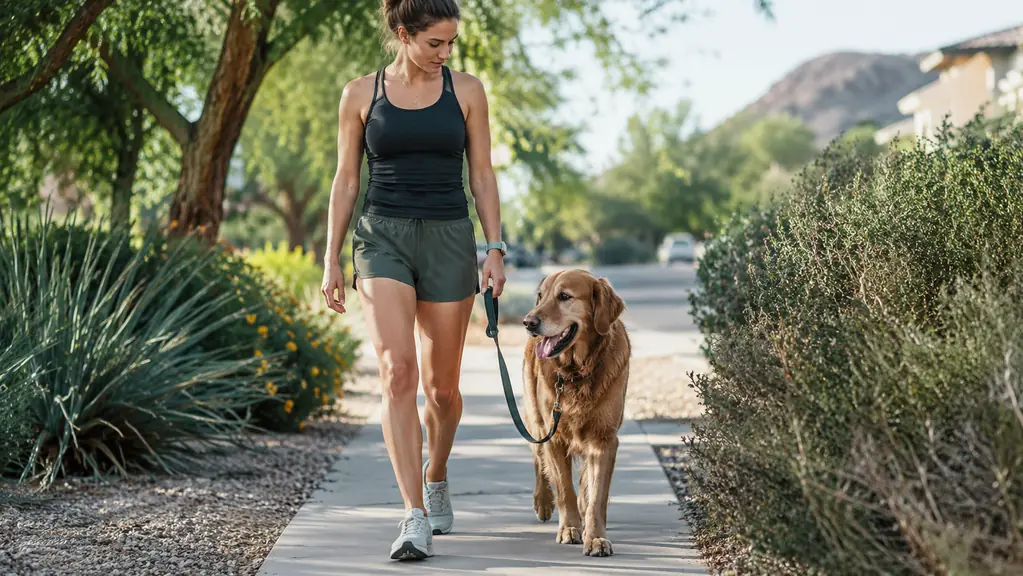
On the first real walk, I kept the expectations low. We went out at 6:30 in the morning, when the street was quiet, and I committed to the same rule we'd used in the yard. Slack leash, we move. Tension, we stop. No yanking, no corrections, just a dead stop until Tucker made a choice. The first walk took us about three blocks in twenty five minutes, and I'm pretty sure half of that time was spent standing still while Tucker thought about it.
The thing that surprised me was how quickly the stops got shorter. Week one, Tucker would test the leash every few steps and we'd stop constantly. Week two, he'd take ten steps before testing. By the end of the month, most walks had maybe two or three stops total, usually when a cat was involved. The key is consistency. Every single time the leash tightened, I stopped. There was no well, we're almost home, I'll let this one slide. One exception tells a dog the rule is optional, and I learned that the hard way.
I also learned not to yank back when he pulled. Jerking the leash just turned it into a tug of war, and Tucker outweighs me on his hind legs. The dead stop works better because it takes the fun out of pulling. There's no payoff, no forward motion, just a bored dog standing on a sidewalk waiting for the walk to continue. Dogs repeat what pays off, and pulling stopped paying off.
Step 5: Build up distance and distractions slowly
Once Tucker was walking loose leash on our quiet morning route, I started adding variables. We went out a little later, when there was more traffic. We walked past the neighbor's yard where the little white dog barks from the window. We did a loop near the park where kids ride bikes. I didn't expect perfection on any of these. I expected the same rule to apply: slack means we move, tension means we stop, and if a bike went by and Tucker lost his mind, we just stood there until he came back to me.
I kept our training walks to about fifteen minutes for the first month, then stretched them to twenty five. Longer walks were tempting because Tucker finally wasn't dragging me, but pushing the distance too fast meant a tired, overwhelmed dog who fell back into old habits. Slow and steady got us further. By the second month, we could do a full mile without a single pull. By the third month, Tucker was walking at my heel like a completely different dog, and Daisy, who's always been polite on the leash, started getting jealous of the attention.
Now, months in, Tucker still has his moments. A squirrel darting across the road will get his attention, and once in a while he'll test the front clip on a windy day. That's normal. The difference is that a bad moment now lasts about five seconds, and then he's back at my side. He's not a robot, and I wouldn't want him to be. He's just a dog who finally learned that a loose leash is the fastest way to get where he wants to go.
What Else Helps
A harness is one tool, not the whole fix. Three things made the biggest difference alongside the rabbitgoo. First, high value treats. I used small bits of boiled chicken, not his regular kibble, so that slack leash moment had a real reward attached to it. Second, I burned off some energy before training walks. A few minutes of fetch in the backyard meant Tucker was a little less frantic when we hit the street. Third, I checked the harness fit about once a month, because he'd put on a pound or two and the straps needed a small adjustment. That's it. No magic, just a harness that works and a routine I stuck with.
If you've got a dog that pulls hard enough to choke on a collar, or one that's figured out how to slip out of a poorly fitted harness, the rabbitgoo is a reasonable place to start. It gave me the control I needed, and it gave Tucker a setup that didn't hurt him. The rest was just repetition, patience, and a lot of standing still on street corners.
The front clip turned a 70 pound puller into a dog who walks at my heel. That one ring did more than every correction I tried in the first year.
Ready to make walks something you both enjoy
The rabbitgoo No Pull Harness with the front chest clip is the tool that made the difference for Tucker and me. Fitted right and used consistently, it's the reason we can do a mile without a single pull.
Amazon Check Today's Price on Amazon →